Alex Growth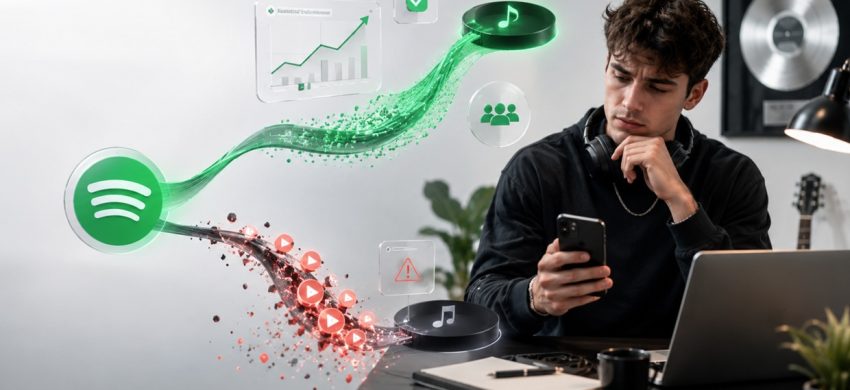
The honest read
Buying Spotify plays isn’t automatically safe or automatically dangerous, it depends entirely on what’s actually being delivered. Bot streams from account farms are the risky version, they get detected, stripped, generate zero royalties, and can trigger distributor penalties or removal from playlists. Real plays from actual listener accounts paced naturally into your track are a different product entirely, they behave like normal listeners, aren’t scrubbed the same way, and function as social proof rather than algorithmic manipulation. The honest safety answer is: the cheap end of the market is dangerous, the quality end is a legitimate promotional tool used carefully.
What “buying Spotify plays” actually means (there are two very different products)
Most articles on this topic lump every kind of paid stream together, which is why so much of the advice online is confusing. In practice there are two fundamentally different products being sold under the same label, and understanding the difference is the whole answer to the safety question.
The first is bot-driven streams. These come from software running fake accounts, account farms operated from server clusters, or emulator setups streaming tracks in loops. They cost almost nothing per thousand plays, they show up as sudden spikes, and Spotify’s detection system reads them clearly against natural listening patterns. This is the version that gets stripped, penalised, and can escalate into distributor action.
The second is streams from real listener accounts, sometimes routed through promotion networks or genuine listener communities. These accounts have listening history, session behaviour that looks like actual users, and pacing that blends into normal traffic. This version is far more expensive per thousand plays, delivers over days rather than hours, and behaves like ordinary streams because in most senses it is ordinary streams.
The safety question changes depending on which of these two products you’re actually buying. Most cheap services are selling the first. Some services sell the second. The prices are wildly different, and the risks are also wildly different.
What actually triggers Spotify’s detection
Spotify’s artificial streaming detection is more sophisticated than a lot of creators realise. The system doesn’t just count plays, it reads patterns across dozens of variables to decide whether traffic looks natural or artificial. Understanding what it flags is how you tell risky purchases from safer ones.
The main signals the detection system watches for:
- Play velocity that doesn’t match audience size: a track jumping from 100 daily streams to 20,000 overnight looks unnatural against the artist’s history.
- Clustered account origins: streams from a small set of accounts, IPs, or device fingerprints signal a farm rather than a real audience.
- Session behaviour that fails human tests: plays that stop at exactly 31 seconds (the royalty threshold), no skips, no shuffles, no library adds, all missing.
- Geographic patterns that don’t match the artist: sudden streams from countries with no marketing activity or fan base.
- Repeat activity from the same accounts: the same 500 accounts streaming the same track 40 times each in a week.
- Zero engagement layered under the plays: no saves, no playlist adds, no follows, just plain streams stacked on the counter.
Bot services fail most of these tests immediately. Real-listener services designed to blend in avoid them by pacing delivery, using accounts with genuine history, and matching geographic patterns to the artist’s likely audience. This is why the price gap between the two exists.
The specific consequences when things go wrong
If your streams do get flagged, the consequences fall across several levels, and creators are often surprised by which one hits first. It’s rarely a Spotify ban straight out of the gate, that’s the worst-case scenario. The more common outcomes come earlier.
The first thing that happens is stream removal. Spotify runs regular sweeps that adjust public counters, and flagged streams drop off the count within days or weeks. This alone isn’t catastrophic, but it means the numbers you paid for don’t stay on the profile, and any social proof value evaporates with them.
The second consequence is at the distributor level. Distributors are legally obligated to enforce anti-fraud policies, and repeated flags on releases can lead to withheld royalties, penalty fees, or in serious cases, removal of releases from the platform. This is where creators actually lose money, both the payment for the fake plays and the royalties they thought they were earning.
The third and most severe consequence is playlist delisting and artist profile penalties. Editorial playlist teams have visibility into flagged accounts, and getting caught can quietly kill future editorial consideration, which is one of the more painful long-term costs. In extreme cases, Spotify can restrict access to Spotify for Artists tools or suspend the artist profile entirely, though this is rare and usually reserved for repeat or large-scale offenders. Buying the wrong kind of plays is one of the bigger versions of the broader problem covered in our guide to mistakes that kill Spotify growth early, all of which can quietly stall a release before it starts.
What safe(r) Spotify plays actually look like
If you decide the promotional value of extra plays outweighs the residual risk, the version of the product that behaves safely shares a few specific traits. Recognising these upfront is how you separate genuine services from the bot-driven end of the market.
- Delivered gradually: real streams arrive over days or weeks, not hours. Overnight delivery is a red flag.
- Priced realistically: services claiming 10,000 plays for a few dollars are selling bot traffic, no exception.
- From accounts with listening history: the accounts sending the streams look like real users, with existing playlists, follows, and session variety.
- Retention-aware: plays that pass the 30-second royalty threshold naturally, not by cutting off at exactly 31 seconds.
- Geographically sensible: streams that fit your natural audience map rather than dumping traffic from unrelated countries.
- No login required: legitimate services only need your public track or playlist link, never your Spotify credentials.
Services that meet these markers exist and can deliver plays that behave like normal listener activity. Real Spotify plays paired with real Spotify followers on the artist profile function as social proof: the numbers on the profile, the monthly listener count, and the play tallies on tracks that visitors see when they land on your page. That’s the legitimate use case, and it’s very different from trying to game royalties or force algorithmic push, which don’t work regardless of what services claim.
What buying plays cannot do, no matter what services promise
This is the part where most sellers oversell and most artists overexpect. Even the highest-quality paid plays cannot deliver certain outcomes, and understanding this before you spend is critical.
Paid plays cannot generate royalties reliably. Spotify’s detection systems, even when they don’t flag streams for removal, often exclude flagged patterns from royalty calculations. Distributors also increasingly withhold royalties on suspicious activity. If a service is selling you monetisable streams, they’re overpromising.
Paid plays cannot buy you editorial placement. Curators evaluate music on artistic merit and profile signals, and they can see stream patterns. A profile with wildly inflated play counts against low real engagement raises questions, not opportunities.
Paid plays cannot force algorithmic push into Discover Weekly or Radio. The algorithm reads dozens of listener behaviour signals, not just play counts. Streams that look like plays but generate no saves, follows, or repeat listens don’t move the algorithm regardless of volume.
What paid plays can do is provide visible social proof for human eyes: the number a listener sees when they land on your profile, the count on a track that makes it look active rather than empty, the monthly listener figure that signals the artist has traction. Framed correctly, that’s a real promotional tool. Framed as royalty generation or algorithm hacking, it’s a scam waiting to hurt you.
Things to be aware of
A few realities worth keeping in mind before deciding either way:
- Cheap always means bots, if the price seems too good to be true, it is. Real listener networks cost significantly more per thousand plays.
- Instant delivery is a red flag, natural streams take time, services that deliver in hours are almost always artificial.
- No service can guarantee royalties, if the sales page implies you’ll earn back your investment through royalties, it’s misleading.
- Distributor policies vary, some are stricter than others, and enforcement has tightened across 2024-2026.
- Combining paid plays with real promotion multiplies value, on their own the numbers look hollow, paired with genuine marketing they support the story.
- Login-based services are the highest risk, giving away your Spotify credentials is how catalogue takedowns happen fastest.
FAQ
Will Spotify ban my account for buying plays?
Full account bans are rare and usually reserved for repeat or large-scale fraud. What’s more common is stream removal, royalty withholding, and reduced editorial consideration. The consequences scale with scale, small amounts of poor-quality traffic often go unnoticed, larger campaigns of the same type get caught.
Can Spotify tell the difference between real and paid plays?
For bot-driven plays, yes, easily. For plays from real listener accounts paced naturally, the detection is far harder because those plays technically are real listening activity. This is why the quality end of the market exists.
Does buying plays help you get on playlists?
Editorial playlists, no. Curators look at overall profile signals and can see suspicious patterns. Algorithmic playlists respond only to genuine listener behaviour. Paid plays provide social proof for visitors, which can indirectly support playlist pitches, but they don’t buy placement.
Are cheap services ever safe?
No. The economics don’t work for real listener accounts at low prices, cheap services are always bot-driven, and the cost savings disappear the moment the streams get stripped or the release gets flagged. Cheap Spotify plays are the single riskiest version of the product.
Will buying plays boost my monthly listeners?
Only if the plays come from unique real accounts, in which case they raise monthly listeners for the reporting window they fall in. Bot streams often use the same small pool of accounts, which barely moves the monthly listener count and creates a suspicious ratio.
Weighing the decision honestly
Whether to buy Spotify plays isn’t a moral question, it’s a risk-management one. The cheap end of the market is a trap that costs money, damages releases, and can escalate into distributor problems. The quality end is a legitimate promotional tool when used correctly, understood correctly, and framed correctly (as social proof, not as royalties or algorithmic magic).
The artists who use paid plays without getting burned share a common pattern. They buy from services that deliver real listener traffic slowly, they never chase suspiciously cheap deals, they combine paid plays with genuine promotion, and they set expectations realistically about what the plays can and cannot do. That combination turns Spotify plays into one more marketing lever alongside social content, pre-saves, and editorial pitching. Misused, the same tool can wreck a release before it starts. The safety depends less on whether you buy and more on what you buy and how.